New MOT Headlight Rules 2026: Which LED Bulbs Are Now Legal?
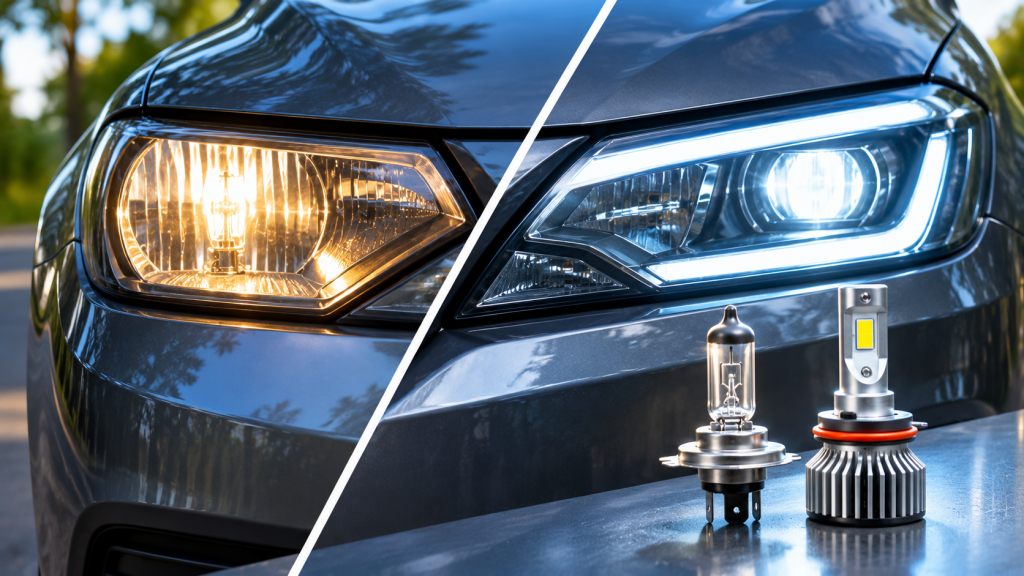
New MOT headlight rules introduced in October 2026 mean that certain approved LED replacement bulbs can now be accepted in vehicles originally fitted with halogen headlights.
The Driver and Vehicle Standards Agency (DVSA) confirmed the change in MOT Special Notice 05-26, published on 13 October 2026, with the updated requirements taking effect from 14 October 2026.
For years, motorists considering replacing traditional halogen headlight bulbs with brighter LED alternatives have faced uncertainty over whether the conversion would cause an MOT failure.
The latest changes provide a route for certain approved LED replacement bulbs to be accepted during an MOT test.
However, there is an important distinction.
Not all aftermarket LED headlight bulbs are permitted, and fitting an LED bulb into an existing halogen headlamp does not automatically make the conversion compliant.
Drivers must ensure that the replacement bulb is specifically approved for use in the relevant headlamp and that the required manufacturer-issued approval sticker is correctly displayed.
Here is what UK motorists need to know.
What Are the New MOT Headlight Rules for 2026?
From 14 October 2026, MOT testers in England, Scotland and Wales must accept certain ECE-approved LED replacement bulbs, commonly referred to as LEDr bulbs, when fitted to compatible halogen headlamp units.
Previously, vehicles first used on or after 1 April 1986 could fail their MOT if their original halogen headlamp units had been converted to use LED bulbs.
The updated rules introduce an exception for approved LED replacement products.
To qualify, the bulb must be approved for use in the particular headlamp and supported by a corresponding manufacturer-issued approval sticker.
The change applies to MOT vehicle classes 3, 4, 5 and 7.
It does not mean drivers can install any LED headlight conversion kit and expect to pass an MOT.
Official source: DVSA – MOT Special Notice 05-26: Approved LED Replacement Bulbs
Which LED Headlight Bulbs Are Now Accepted at MOT?
Under the updated DVSA guidance, LED replacement bulbs may be accepted when they satisfy the relevant approval requirements.
The principal conditions are:
The LED replacement bulb must have the appropriate ECE approval.
The approval must cover its use in the particular halogen headlamp.
The installation must be supported by a corresponding manufacturer-issued approval sticker.
The sticker must be permanently attached to the vehicle and clearly visible during the MOT inspection.
The headlamps must continue to meet the other applicable MOT requirements, including correct operation, light output and alignment.
For example, a driver replacing an H11 halogen bulb cannot assume that any H11 LED replacement will be acceptable.
The particular LED replacement product must have the relevant approval for the headlamp in which it is installed.
Does an ECE Approval Mark Mean Any LED Bulb Is Acceptable?
No.
An approval marking alone does not establish that a particular replacement bulb is suitable for every vehicle or headlamp.
The product must be approved for the specific application.
Drivers should check the bulb manufacturer’s compatibility and approval information before purchasing or fitting replacement bulbs.
A bulb being advertised as road legal, E-marked or MOT compliant is not, by itself, sufficient evidence that it is approved for use in your particular headlamp.
What Is the New LED Headlight Approval Sticker?
One of the most important elements of the October 2026 MOT changes is the requirement for a manufacturer-issued approval sticker.
The DVSA states that approved LED replacement products must be supported by a secure sticker that is permanently affixed to the vehicle.
The sticker must be readily visible to the MOT tester.
It must contain relevant identification and approval information, including:
LED replacement bulb category, such as H11 LEDr.
Product variant.
Rated voltage.
ECE approval number.
Manufacturer’s name.
An anti-counterfeit security feature, such as a hologram.
The sticker’s appearance may vary between manufacturers.
What Happens If the Approval Sticker Is Missing?
The DVSA instructs MOT testers to reject an LED replacement conversion where the required sticker is missing, illegible, damaged, apparently tampered with or inconsistent with the fitted bulb.
For vehicles subject to these compatibility checks, this is recorded as a major defect.
The relevant MOT defect is:
Light source and lamp not compatible.
This results in an MOT failure.
Importantly, MOT testers are not normally required to dismantle the headlamp or check the approval number against external databases.
The manufacturer-issued sticker provides evidence of the approved installation for the MOT inspection.
Drivers should nevertheless ensure that the bulb and installation genuinely satisfy the applicable approval requirements.
Official guidance: DVSA MOT Inspection Manual – Section 4.1.4
Which Vehicles Are Covered by the New LED Headlight Rules?
The October 2026 change applies to specified vehicle classes tested under the DVSA MOT inspection manual for cars and passenger vehicles.
| MOT class | Vehicle category | New LED replacement provision |
|---|---|---|
| Class 3 | Certain three-wheeled vehicles | Applicable |
| Class 4 | Cars and other qualifying vehicles | Applicable |
| Class 5 | Certain private passenger vehicles | Applicable |
| Class 7 | Qualifying goods vehicles | Applicable |
| Class 1 | Smaller motorcycles | Not covered by this change |
| Class 2 | Other motorcycles | Not covered by this change |
The precise MOT classification depends on the vehicle’s construction, weight and use.
Do the New Rules Apply to Motorcycles?
The October 2026 special notice does not extend the new LED replacement approval-sticker provisions to Class 1 or Class 2 motorcycles.
Motorcycles are assessed under a separate MOT inspection manual.
Different motorcycle headlamp inspection rules have applied since changes introduced in March 2021.
Motorcycle owners should therefore consult the relevant motorcycle inspection requirements rather than assuming that the new car and passenger vehicle rules apply to their machines.
Official source: DVSA – Motorcycle MOT Inspection Manual
Can You Replace Halogen Headlight Bulbs with LEDs on Any Car?
No.
The updated MOT rules do not provide blanket permission for all LED conversions.
For vehicles first used on or after 1 April 1986, an existing halogen headlamp must not be converted to use an LED replacement bulb that has not been approved for that particular lamp.
A suitable replacement must meet the applicable approval requirements and be supported by the correct manufacturer-issued sticker.
Drivers should also check whether any additional fitting requirements apply to their particular vehicle.
What About Cars Built Before April 1986?
The MOT inspection manual provides a specific distinction for older vehicles.
For vehicles first used before 1 April 1986, compatibility between the headlamp unit and its light source is not assessed as part of the MOT test and is not itself grounds for rejection.
However, the headlamps must still satisfy the other applicable MOT requirements.
This exemption from an MOT compatibility check should not be interpreted as blanket confirmation that every lighting modification is lawful for road use.
Vehicle owners remain responsible for ensuring that their lighting equipment complies with the relevant legal requirements.
Are HID or Xenon Headlight Conversions Now Allowed?
The October 2026 changes specifically concern approved LED replacement bulbs.
They do not introduce equivalent permission for fitting high-intensity discharge (HID) bulbs into existing halogen headlamp units.
For vehicles first used on or after 1 April 1986, converting an existing halogen headlamp to use HID light sources remains a reason for MOT rejection under the relevant inspection requirements.
There is also an important distinction between replacing a bulb and replacing an entire headlamp assembly.
What About Complete LED Headlamp Units?
A complete replacement headlamp manufactured with LED or HID technology is assessed differently from a conversion involving replacement bulbs inside an existing halogen headlamp.
The DVSA states that complete replacement units must not automatically be rejected under the incompatible-light-source defect simply because they use LED or HID technology.
However, they must still satisfy the other applicable headlamp inspection requirements.
Motorists should not assume that any aftermarket headlamp assembly is suitable or legally compliant merely because it is sold as a complete unit.
Can LED Headlights Still Cause an MOT Failure?
Yes.
Even where an LED replacement bulb has the appropriate approval, a vehicle can still fail its MOT if the headlamps do not meet the required standards.
Potential problems include incorrect beam alignment, unsuitable light output, damaged components and incompatible light sources.
Incorrect Headlight Alignment
Headlights must be correctly adjusted to illuminate the road without creating excessive glare for other road users.
A badly aligned headlamp can cause an MOT failure.
Incorrect Light Colour
Headlamps must produce a colour permitted by the applicable inspection requirements.
An unsuitable colour can result in a failure.
Damaged or Defective Headlamps
Headlamps may fail if they are insecure, seriously damaged or do not function as required.
Unapproved LED Conversions
For vehicles subject to the compatibility requirements, fitting an unapproved LED bulb into an existing halogen headlamp can result in a major defect.
Missing Approval Sticker
An otherwise suitable LED replacement installation may also be rejected if its required approval sticker is missing or does not satisfy the DVSA requirements.
These rules highlight why motorists should check both product approval and installation quality before modifying their vehicle’s lighting.
What Does a Headlight MOT Failure Mean?
When a headlamp fails an MOT, the tester records the relevant defect and its severity.
A major defect means the vehicle has failed the MOT because a significant issue requires attention.
A dangerous defect indicates a more serious problem involving an immediate risk to road safety or the environment.
Drivers should not assume that a vehicle remains safe or legal to drive simply because its previous MOT certificate has not yet expired.
The actual defect and the vehicle’s roadworthiness must be considered.
Understand Your MOT Results with Motor Bridge UK
If your vehicle has failed an MOT because of a headlamp defect, Motor Bridge UK’s MOT Checker & Explainer can help you understand the recorded information.
The free tool allows motorists to:
Check their latest recorded MOT result.
View previous MOT tests.
Identify recorded failures and advisories.
Read plain-English explanations of supported MOT defects.
Better understand why an issue matters and what action may be appropriate.
Check Your MOT History & Understand Your Results – Motor Bridge UK
Enter your registration number to view available MOT history and explanations.
Motor Bridge UK provides independent explanations based on available MOT records. It does not carry out vehicle inspections or provide an official assessment of individual lighting modifications.
Will Brighter LED Headlights Make Driving Safer?
LED headlight technology can offer advantages, including energy efficiency and potentially improved illumination.
However, brighter lighting does not automatically mean safer lighting.
Headlamp design, beam distribution, alignment and compatibility are important factors.
An unsuitable LED bulb fitted to a halogen headlamp can alter the intended light distribution.
This may reduce effective visibility or increase glare for approaching motorists.
The Department for Transport has published advice addressing headlight glare and the importance of using approved lighting equipment.
Its guidance advises motorists not to fit non-approved bulbs or light sources.
Further reading: GOV.UK – Minimising Headlight Glare and Its Effects
Can Fitting LED Headlights Affect Car Insurance?
Vehicle lighting modifications may be relevant to an insurance policy, depending on the modification and the insurer’s terms.
Drivers considering changing their vehicle’s headlamps should check whether the proposed modification needs to be declared.
A product being acceptable under MOT inspection requirements does not automatically settle questions about insurance cover.
If an insurer requires modifications to be disclosed, failing to provide relevant information could affect the policy or a subsequent claim, depending on the circumstances.
Before modifying your headlights, check the insurer’s requirements and retain any relevant installation and approval documentation.
What Should Drivers Check Before Buying LED Replacement Bulbs?
If you are considering upgrading existing halogen headlights, it is worth carrying out several checks before buying replacement bulbs.
Check vehicle compatibility. Confirm that the proposed LED replacement product is approved for the specific headlamp fitted to your vehicle.
Confirm ECE approval. Check the manufacturer’s official documentation rather than relying solely on retailer advertising.
Check the approval sticker. Ensure the required manufacturer-issued sticker is provided and can be permanently displayed as instructed.
Consider professional installation. Incorrect fitting can affect headlamp performance, alignment or electrical operation.
Check headlamp alignment. The correct beam pattern and aim are important for both safety and MOT compliance.
Contact your insurer where necessary. Check whether the modification must be declared under your policy.
Keep supporting documentation. Retain product approval information and installation records for future reference.
Drivers uncertain about the suitability of a replacement bulb should seek advice from the manufacturer or a suitably qualified vehicle lighting specialist.
Frequently Asked Questions: LED Headlight MOT Rules 2026
Are LED headlight bulbs legal in the UK in 2026?
Certain approved LED replacement bulbs can now be accepted in compatible halogen headlamps during MOT tests in England, Scotland and Wales. The product must be approved for the particular headlamp and supported by the required manufacturer-issued approval sticker. MOT acceptance does not remove the need to comply with applicable road-use legislation.
When did the new LED headlight MOT rules start?
The updated requirements took effect on 14 October 2026, following DVSA Special Notice 05-26, published on 13 October 2026.
Can I fit LED bulbs into my existing halogen headlights?
Potentially, but only where the particular LED replacement product is approved for use in the relevant headlamp and the applicable requirements are satisfied.
Will aftermarket LED bulbs fail an MOT?
Unapproved LED replacements fitted into existing halogen headlamps can cause an MOT failure on vehicles subject to the compatibility requirements. Approved replacements may be accepted if they meet the relevant conditions.
Do LED bulbs need an approval sticker?
Yes. Under the new approval provisions for applicable vehicles, the manufacturer-issued sticker must be permanently fitted and readily visible during the MOT inspection.
Can I use an LED conversion kit bought online?
Do not assume an LED conversion kit is suitable simply because it is advertised as road legal or MOT compliant. Confirm the specific product’s approval and compatibility with your headlamp.
Do the new rules apply to motorcycles?
No. The October 2026 changes apply to MOT Classes 3, 4, 5 and 7. Motorcycles in Classes 1 and 2 have separate inspection requirements.
Can I still fail an MOT with approved LED bulbs?
Yes. Approval does not exempt the headlamps from other MOT requirements, including operation, alignment, colour and condition.
Motor Bridge UK: Helping You Understand Your MOT
The October 2026 changes provide greater clarity for motorists considering approved LED headlight replacements.
However, the new rules do not mean that all LED conversion kits are suitable for road use.
Vehicle owners should check the relevant approval requirements, follow manufacturer instructions and ensure their headlights remain correctly fitted and aligned.
Motor Bridge UK helps motorists understand vehicle maintenance, MOT requirements and recorded defects through practical guides and helpful tools.
If you want to review your vehicle’s MOT history or better understand a previous failure or advisory, our MOT Checker & Explainer provides clear, accessible information.
Motor Bridge UK – Check Your MOT Results & History
For professional assistance with lighting defects, servicing or repairs, explore:
Motor Bridge UK – Garage, Servicing, Repair & MOT Solutions
Official Sources and Further Reading
This article is based primarily on official Driver and Vehicle Standards Agency guidance.
DVSA – MOT Special Notice 05-26: Approved LED Replacement Bulbs
DVSA – MOT Inspection Manual, Section 4: Lamps, Reflectors and Electrical Equipment
DVSA – Updates to the MOT Inspection Manual
GOV.UK – Minimising Headlight Glare and Its Effects
Important Information
This article is provided by Motor Bridge UK for general motoring information and public awareness.
The information reflects DVSA MOT inspection guidance applicable in England, Scotland and Wales as of 7 November 2026.
Northern Ireland operates separate vehicle testing arrangements, and motorists should consult the relevant authorities for applicable requirements.
MOT inspection standards and legal requirements governing vehicle lighting are not necessarily identical. Passing an MOT does not, by itself, establish that every aspect of a vehicle modification is lawful for road use.
Approval of an LED replacement product must be assessed against its intended application, relevant manufacturer documentation and applicable requirements.
Motor Bridge UK is an independent motoring information service and is not affiliated with or endorsed by DVSA, the Department for Transport or the UK Government.
Our MOT Checker & Explainer provides general explanations of recorded MOT information. It does not replace professional vehicle inspections, official guidance or specialist legal advice.
For definitive guidance on a particular vehicle or lighting modification, consult the relevant manufacturer, a suitably qualified specialist or the appropriate authority.
Motor Bridge UK — Bridging the gaps to smarter motoring.