
Why Do Car Batteries Give Up in the Winter?
Winter in the UK doesn’t just test drivers — it tests vehicles too.
From frosty mornings and icy windscreens to dark commutes and constant heater use, colder months place extra strain on every part of your car. But one of the most common and frustrating winter problems is a flat battery and not everyone understands why car batteries fail in winter.
If you’ve ever turned the key on a freezing morning only to hear a slow crank… or worse, just a clicking sound — you’ll know exactly how disruptive it can be. Suddenly your day stops before it’s even begun.
Battery-related breakdowns surge across the UK every winter. But why does this happen? And more importantly, can it be prevented?
In this detailed guide from Motor Bridge UK, we explain exactly why car batteries fail in winter, what warning signs to look for, and how to reduce your risk of being stranded when temperatures drop.
How a Car Battery Works
Most UK vehicles use a 12-volt lead-acid battery. Its job is straightforward but essential:
-
Deliver power to start the engine
-
Supply electricity to onboard electronics
-
Stabilise voltage across systems
-
Support power when demand spikes
When you start your car, the battery sends a high burst of current to the starter motor. Once the engine fires up, the alternator recharges the battery while powering the vehicle’s electrical systems.
The entire process depends on chemical reactions inside the battery. And this is where winter begins to cause problems.
1. Cold Temperatures Reduce Battery Power
The primary reason why car batteries fail in winter is simple: cold weather slows down chemical reactions.
Inside the battery, lead plates react with sulphuric acid to generate electricity. In low temperatures, this chemical reaction becomes sluggish. The colder it gets, the less power the battery can produce.
At around 0°C, a battery can lose roughly 20% of its strength.
At -10°C, power loss can reach 40% or more.
While UK winters are rarely extreme, even temperatures between 0–5°C are enough to significantly weaken battery performance.
At the same time, cold weather thickens engine oil. Thicker oil makes the engine harder to turn over. So your car demands more starting power precisely when your battery is delivering less.
This mismatch is one of the biggest reasons why car batteries fail in winter.
2. Increased Electrical Demand
Winter increases how much electricity your vehicle uses.
Think about what’s switched on during colder months:
-
Headlights (used longer due to shorter daylight hours)
-
Heated rear window
-
Heated mirrors
-
Heated seats
-
Blower motor and heater
-
Windscreen wipers
-
Demisters
Each of these systems draws power. If you’re doing short trips — school runs, short commutes, quick errands — your battery may not have enough time to fully recharge between uses.
Over days and weeks, this gradual drain contributes heavily to winter battery failure.
3. Short Journeys Are a Major Contributor
Many UK motorists mainly use their cars for short local trips. While convenient, short journeys are tough on batteries.
Here’s why:
-
Starting the engine uses significant power
-
Alternators need time to recharge the battery
-
Journeys under 15 minutes may not replenish what was used
If your driving routine consists mostly of short trips, your battery is constantly operating in a slight deficit.
When winter arrives, that weakened battery finally reaches its limit. This is another key factor explaining why car batteries fail in winter.
4. Ageing Batteries Struggle in the Cold
Car batteries don’t last forever. On average, most last between 3 and 5 years.
As batteries age:
-
Internal components degrade
-
Charge capacity reduces
-
Resistance increases
-
Performance weakens
Cold weather doesn’t create the damage — it exposes it.
If your battery is approaching 4 or 5 years old, winter will likely reveal its condition. Many winter breakdowns happen because a battery was already nearing the end of its lifespan.
5. Corrosion and Poor Connections
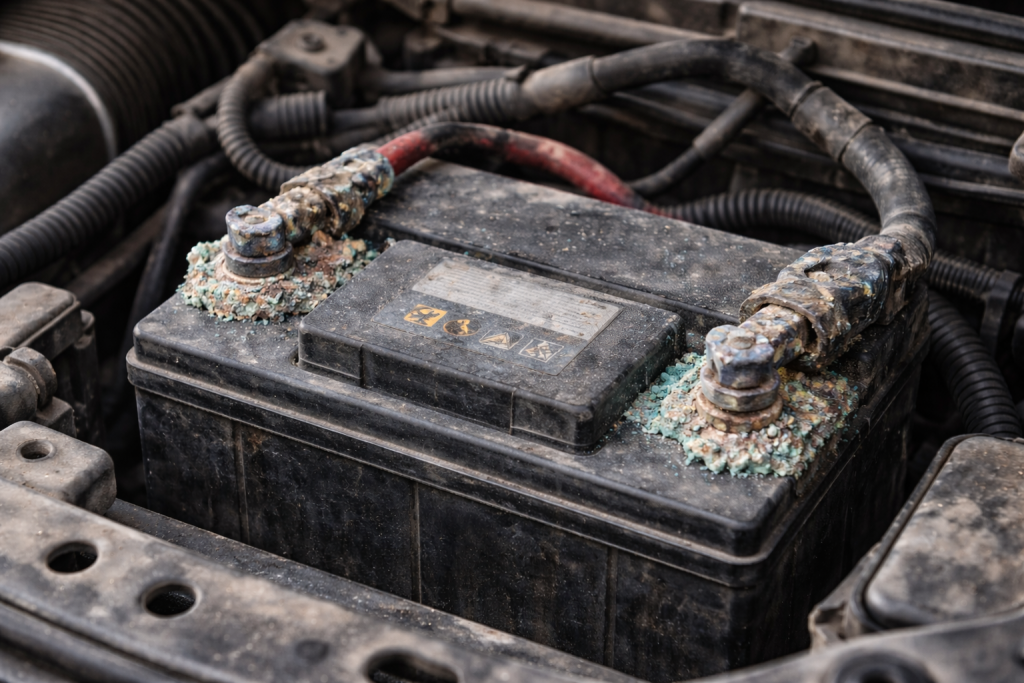
Battery terminals can corrode over time, forming a white or bluish powder around connections.
This corrosion:
-
Increases electrical resistance
-
Reduces current flow
-
Weakens starting power
-
Limits charging efficiency
Even a relatively healthy battery can struggle if the electrical connection is compromised.
Loose clamps can also cause intermittent starting problems, especially when metal contracts in cold conditions.
Regular visual checks under the bonnet during winter can prevent unnecessary issues.
6. Charging System Problems
Sometimes the battery isn’t the root cause at all.
If your alternator isn’t charging correctly, the battery will gradually lose power. Winter simply accelerates the problem.
Signs of charging issues include:
-
Battery warning light on dashboard
-
Dim headlights
-
Electrical systems fluctuating
-
Battery repeatedly going flat
If a new battery fails quickly, the alternator or voltage regulation system should be inspected.
Common Warning Signs Before Failure
Batteries rarely fail without warning. Look out for:
-
Slower engine cranking
-
Clicking sound when starting
-
Dashboard lights dimming during startup
-
Stop/start systems not functioning
-
Electrical systems behaving inconsistently
Recognising these early signs can help you act before complete failure.
Understanding why car batteries fail in winter gives you the advantage of prevention rather than reaction.
How to Prevent Winter Battery Failure
While winter conditions can’t be controlled, preparation can.
✔ Take Longer Drives Occasionally
A 20–30 minute drive once a week allows the alternator to recharge the battery properly.
✔ Switch Off High-Drain Systems Before Startup
Turn off heated seats, rear demisters and lights before starting the engine.
✔ Check and Clean Terminals
Remove corrosion carefully and ensure clamps are secure.
✔ Get a Battery Health Check
Many garages offer free winter battery tests.
✔ Replace Proactively
If your battery is older than four years, replacing it before winter can be more cost-effective than a breakdown recovery.
Hybrid and Electric Vehicles in Winter
Even hybrid and electric vehicles can experience winter battery-related issues.
While EVs don’t rely on a traditional starter motor, they still use a 12V auxiliary battery for control systems and startup procedures.
Cold weather can:
-
Reduce EV driving range
-
Increase energy consumption for cabin heating
-
Impact battery efficiency
So although the mechanics differ, winter still affects battery systems across all vehicle types.
Why Winter Sees a Spike in Breakdown Callouts
UK roadside assistance organisations like the AA and RAC consistently report that flat batteries are one of the leading causes of winter breakdowns.
The majority of these cases are preventable with simple checks and proactive maintenance.
The Real Cost of Ignoring Battery Health
A flat battery doesn’t just cause inconvenience.
It can mean:
-
£80–£150 for replacement
-
£100+ emergency callout fees
-
Lost work time
-
Missed appointments
-
Safety risks if stranded
For fleet vehicles or business users, downtime costs can be significantly higher.
Understanding why car batteries fail in winter isn’t just useful knowledge — it’s practical financial protection.
Final Thoughts: Preparation Beats Recovery
Cold weather doesn’t destroy healthy batteries overnight. It exposes weaknesses that have been building over time.
When temperatures drop:
-
Chemical reactions slow
-
Electrical demand increases
-
Ageing components struggle
-
Short journeys compound the problem
The result is often a failure on the coldest morning of the year.
But winter battery breakdowns are rarely random. They’re usually predictable — and preventable.
At Motor Bridge UK, we believe that informed drivers make smarter decisions. Knowing why car batteries fail in winter helps you take simple steps that can save time, money and stress.
A quick check today could prevent a frozen driveway frustration tomorrow.
Stay prepared. Stay aware. Stay moving.
Motor Bridge UK — bridging the gaps to smarter motoring.
For vehicle batteries and vehicle parts check out our Parts & Tools page where you can find some of the UK’s leading parts suppliers and connect straight to them and check out their prices for yourself.