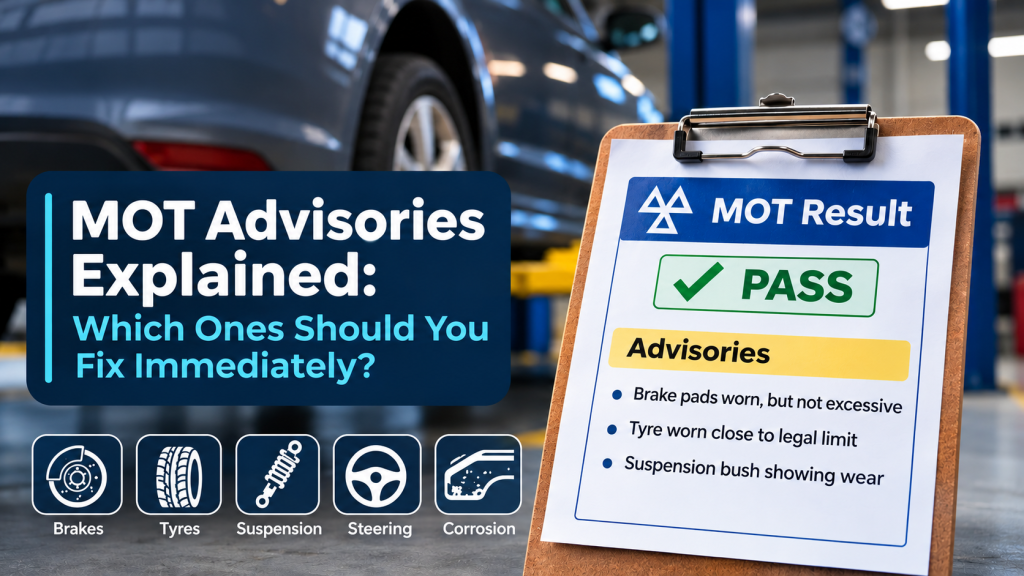
MOT Advisories Explained: Which Ones Should You Fix Immediately?
Your vehicle has passed its MOT, but the certificate lists several advisories. Should you be worried? Do you need to arrange repairs straight away, or can they wait until your next service?
An MOT advisory doesn’t automatically mean your vehicle is unsafe or that it requires immediate repairs. However, some advisories highlight developing problems that could affect your safety, lead to expensive repairs or eventually result in an MOT failure.
Understanding the difference can help you make informed decisions about maintaining your vehicle.
In this Motor Bridge UK guide, we explain what MOT advisories mean, which ones deserve priority and what steps you should take to keep your vehicle safe and roadworthy.
What Is an MOT Advisory?
An MOT advisory is a note recorded by an MOT tester to highlight a potential concern with your vehicle.
Advisories generally relate to components showing signs of wear, deterioration or other conditions that the tester believes should be brought to your attention.
An advisory may indicate that:
A component is showing signs of wear but has not reached the MOT failure threshold.
A part may require maintenance or replacement in the future.
An issue should be monitored to ensure it doesn’t become more serious.
A particular part of the vehicle could not be fully inspected.
Importantly, an advisory does not automatically mean your vehicle has failed its MOT.
A vehicle can pass its MOT while receiving multiple advisories.
The government’s guidance on MOT test results confirms that vehicles may pass with minor defects or advisories that should be monitored or addressed in the future.
However, a valid MOT certificate does not guarantee that a vehicle will remain roadworthy throughout the following year.
Vehicle owners and drivers remain responsible for ensuring their vehicles are safe to use on public roads.
MOT Advisories vs Minor, Major and Dangerous Defects
Not every issue recorded during an MOT has the same significance.
The MOT testing system distinguishes between advisories and three formal defect categories.
| MOT classification | What it means | Recommended action |
|---|---|---|
| Advisory | A potential concern that may require monitoring or future attention. | Monitor and arrange repairs when necessary. |
| Minor | A defect that has no significant effect on safety or the environment. | Arrange repairs as soon as possible. |
| Major | A defect that may affect safety, the environment or other road users. | Arrange prompt repairs. The vehicle fails its MOT. |
| Dangerous | A defect presenting a direct and immediate risk to road safety or a serious environmental concern. | Do not drive until the defect has been repaired. The vehicle fails its MOT. |
A vehicle with only minor defects can still pass its MOT, whereas major and dangerous defects result in failure.
An advisory is different from a minor defect and is not itself a formal defect severity classification.
These classifications are explained in the official DVSA MOT Inspection Manual.
Motor Bridge Tip: Don’t judge the seriousness of a problem solely by whether your MOT certificate says PASS. Consider the component involved, its condition and whether the issue could affect safe driving.
Which MOT Advisories Should You Fix First?
Although advisories don’t automatically require immediate repairs, certain components deserve particularly close attention.
Our recommendation is to prioritise advisories involving essential safety systems.
The following priorities are general Motor Bridge safety guidance, not official DVSA advisory classifications.
1. Brake System Advisories
Motor Bridge priority: High — arrange a prompt inspection.
Your vehicle’s braking system is essential for controlling speed and stopping safely.
Common brake-related advisories include:
Brake pads showing signs of wear.
Brake discs worn, pitted or corroded.
Slight deterioration of brake pipes.
Brake components beginning to show excessive wear.
Why it matters
Brake components can deteriorate with continued use.
Depending on the nature and extent of the problem, deterioration could eventually affect braking performance or lead to an MOT failure.
For example, an advisory for worn brake pads may indicate that replacement will be required before your next MOT.
What should you do?
Arrange for a qualified mechanic to assess the condition of the affected components and advise whether repairs are needed.
If you notice reduced braking performance, unusual grinding noises, a brake warning light or other symptoms suggesting a braking fault, seek professional advice before driving further.
Do not assume that an advisory means the braking system will remain safe for another 12 months.
Official guidance: The DVSA brake inspection requirements explain how braking components are assessed during an MOT.
2. Tyre Wear and Damage Advisories
Motor Bridge priority: High — check tyre condition promptly.
Tyres are the only parts of your vehicle that normally remain in direct contact with the road.
Their condition can affect braking, steering and grip.
Common tyre advisories include:
Tyre tread approaching the legal minimum.
Uneven tyre wear.
Signs of tyre deterioration.
Damage that has not reached the MOT rejection threshold.
Why it matters
For most cars and light vans, the legal minimum tyre tread depth is 1.6mm across the central three-quarters of the tread and around the entire circumference.
However, a tyre can still require attention even when its tread depth remains above the legal minimum.
Uneven wear may indicate an issue with wheel alignment, suspension or tyre pressure.
What should you do?
Check your tyres regularly, including tread depth, pressure and visible damage.
If an advisory identifies low tread or tyre damage, arrange an assessment promptly.
If you discover a bulge, serious damage or another condition that may make a tyre unsafe, do not continue driving until it has been professionally assessed and any necessary repairs completed.
Official guidance: The Highway Code’s vehicle maintenance guidance explains the legal requirements for tyre condition, tread depth and inflation.
You can also review the DVSA tyre inspection standards.
Motor Bridge Tip: Don’t wait until a tyre reaches the legal tread limit before considering replacement. Tyre condition, weather, mileage and driving requirements should all influence your decision.
3. Suspension Advisories
Motor Bridge priority: High where safety-related wear is identified.
Your vehicle’s suspension helps maintain stability, control and contact between the tyres and the road.
Common advisories include:
Suspension bushes deteriorating.
Slight wear in suspension joints.
Shock absorbers showing signs of wear.
Suspension components displaying corrosion.
Why it matters
A worn suspension component can deteriorate over time.
Depending on the component involved, this may eventually affect handling, tyre wear or vehicle stability.
What should you do?
Arrange an inspection to establish the extent of the wear.
If you experience knocking noises, unusual vehicle movement, steering instability or significant changes in handling, seek professional advice promptly.
The urgency of repairs should be based on the actual condition of the component, not simply the presence of an advisory.
Official guidance: Suspension components are covered under Section 5 of the DVSA MOT Inspection Manual.
4. Steering System Advisories
Motor Bridge priority: High — seek professional assessment promptly.
The steering system is fundamental to maintaining control of your vehicle.
Potential advisories may involve:
Wear in steering joints.
Slight deterioration of steering components.
Components beginning to develop excessive movement.
Early signs of corrosion affecting steering-related parts.
Why it matters
Progressive wear in steering components can eventually affect steering precision or vehicle control.
Although an advisory means the recorded condition did not justify an MOT failure at the time of inspection, further deterioration may occur.
What should you do?
Have steering-related advisories assessed by a qualified mechanic.
If the steering feels loose, unusually heavy, unpredictable or otherwise abnormal, avoid driving until the cause has been assessed and the vehicle confirmed safe.
Official guidance: See the DVSA steering inspection requirements.
5. Vehicle Corrosion Advisories
Motor Bridge priority: Depends on location and severity.
Corrosion can appear on different parts of a vehicle, and not every instance presents the same level of concern.
Common advisories include:
Surface corrosion on structural components.
Corrosion developing around suspension mounting areas.
Early deterioration of underbody components.
Brake pipes showing signs of corrosion.
Why it matters
Corrosion may continue to develop, particularly where vehicles are exposed to road salt, moisture and harsh weather.
Corrosion affecting structural areas, braking components or safety-critical mounting points can become particularly important.
What should you do?
Ask a garage to identify the affected area and assess its condition.
Surface corrosion on a non-critical component may require monitoring or preventative treatment.
However, corrosion affecting structural or safety-critical components should receive prompt professional attention.
Official guidance: The DVSA provides specific guidance on structural integrity and corrosion, including how corrosion is assessed during an MOT.
Motor Bridge Tip: If an advisory concerning corrosion appears repeatedly across several MOT tests, investigate whether the condition is progressing rather than assuming it has remained unchanged.
MOT Advisories That May Be Less Urgent
Not every advisory requires an immediate garage appointment.
Some issues may be suitable for monitoring or addressing during scheduled maintenance, provided the vehicle remains safe and roadworthy.
Minor Exhaust Deterioration
An exhaust component showing early signs of corrosion may not require immediate replacement.
However, exhaust leaks, insecure components or unusual fumes should be assessed promptly.
Light Surface Corrosion
Surface corrosion on a non-structural component may be suitable for monitoring or preventative treatment.
Its location and extent are important.
Early Wear on Non-Critical Components
Some components can show minor deterioration without immediately affecting vehicle safety.
A professional inspection can help establish whether the condition requires repairs or continued monitoring.
Important: These are general examples, not guarantees that a specific advisory is safe to postpone. The precise condition and location of the problem determine the appropriate action.
Can You Legally Drive With MOT Advisories?
Generally, yes — provided your vehicle is otherwise legal, safe and roadworthy.
An MOT advisory does not automatically invalidate your MOT certificate or prohibit you from driving.
However, there is an important distinction between having a valid MOT and having a roadworthy vehicle.
Under UK roadworthiness requirements, drivers are responsible for ensuring their vehicles remain safe to use.
A vehicle can become unsafe between MOT tests.
For example, a tyre that was above the legal tread limit during its MOT may subsequently wear below the required minimum.
Similarly, a developing brake or steering problem may worsen after the test.
The government’s vehicle roadworthiness guidance explicitly explains that a vehicle can be unsafe even when it has a current MOT certificate.
The guidance also explains that driving a vehicle in a dangerous condition can result in penalties, including fines, penalty points and disqualification.
An MOT pass should therefore never be treated as a guarantee that all components will remain safe until the next inspection.
Remember: If you believe a defect makes your vehicle unsafe, do not continue driving simply because the MOT certificate is still valid.
Can MOT Advisories Become MOT Failures?
Yes.
An advisory recorded during one MOT may become a major or dangerous defect at a later inspection if the component deteriorates sufficiently.
However, this is not inevitable.
Some advisories remain unchanged, while others are resolved through maintenance or repairs.
For example:
First MOT: A tester records an advisory for a worn suspension bush.
During the following year: Continued use may cause additional deterioration.
Next MOT: If the wear reaches the relevant rejection threshold, the vehicle may fail its MOT.
This is an illustrative scenario rather than a prediction of how quickly a particular component will deteriorate.
The important lesson is that advisories provide an opportunity to identify potential problems before they become more serious.
You can review the official MOT defect classification guidance to understand how testers distinguish minor, major and dangerous defects.
Why Do Some MOT Advisories Appear Year After Year?
You may notice the same advisory appearing on several consecutive MOT certificates.
There are several possible explanations.
The condition may not have deteriorated significantly, the component may still be within acceptable limits, or the issue may simply not have been repaired.
However, repeated advisories should not automatically be dismissed.
For example, a component recorded as corroded across multiple MOT tests may require further investigation to establish whether the corrosion is progressing.
Comparing previous MOT records can help identify recurring concerns, but the recorded wording alone may not reveal the component’s current condition.
A physical inspection is the most reliable way to establish whether repairs are required.
You can review available past MOT results through the official GOV.UK MOT history service.
Alternatively, the Motor Bridge MOT Explainer can help you understand recorded results through plain-English explanations.
How to Check and Understand Your MOT Advisories
If your latest MOT certificate contains unfamiliar technical descriptions, you don’t have to work out what they mean on your own.
The Motor Bridge UK MOT Explainer is designed to make MOT results easier to understand.
Simply enter your vehicle registration to explore available MOT history and recorded defects.
The tool can help you:
Review available previous MOT results.
Identify recorded advisories and failures.
Understand technical defect descriptions in simpler language.
Learn why particular vehicle components matter.
Explore general guidance about possible causes and next steps.
Recognise recurring entries in your vehicle’s MOT history.
Understand Your MOT Results With Motor Bridge
Your MOT history tells you what was recorded. Motor Bridge helps explain what it means.
Explore your vehicle’s MOT results and understand unfamiliar defect descriptions in straightforward language.
[Check Your MOT Results & History — Motor Bridge UK]
Motor Bridge provides general vehicle information and guidance. Its explanations are not a mechanical diagnosis or a substitute for inspection by a qualified professional.
Should You Repair Every MOT Advisory?
Not necessarily.
An advisory does not automatically mean a component must be replaced.
The appropriate response depends on several factors, including:
The component involved.
Its current condition and level of deterioration.
Whether the issue affects safety.
The manufacturer’s maintenance recommendations.
Your vehicle’s age, mileage and usage.
Advice from a suitably qualified mechanic.
Replacing every component mentioned in an advisory could result in unnecessary expenditure.
However, ignoring all advisories could allow developing faults to become more expensive or potentially dangerous.
The sensible approach is to assess each advisory individually and prioritise safety-related concerns.
Where repairs are recommended, consider obtaining a clear explanation of the fault and a written quotation before authorising non-emergency work.
How to Reduce MOT Advisories in the Future
Regular vehicle maintenance can help identify deterioration before it becomes serious.
Consider making the following checks part of your usual vehicle care routine.
1. Check your tyres
Monitor tread depth, inflation pressure and visible damage.
2. Monitor braking performance
Seek advice about unusual noises, reduced effectiveness or warning lights.
3. Pay attention to steering and suspension
Investigate knocking noises, vibration or changes in handling.
4. Inspect visible lights
Check that required exterior lighting operates correctly.
5. Follow servicing recommendations
Use the maintenance intervals and specifications provided by your vehicle manufacturer.
6. Review previous MOT results
Identify recurring advisories and ask your garage whether further investigation is appropriate.
The government provides a useful vehicle safety checklist explaining the routine checks drivers should perform.
Preventative maintenance can help reduce unexpected repair costs and support safer motoring.
However, no maintenance routine can guarantee an advisory-free MOT.
Frequently Asked Questions About MOT Advisories
Does an MOT advisory mean my car has failed?
No.
A vehicle can pass its MOT with advisories. An advisory identifies a concern that may require monitoring or future attention.
Major or dangerous defects result in an MOT failure.
For further information, see the official MOT test result guidance.
Do I have to repair MOT advisories?
There is no automatic requirement to repair an item solely because it has been recorded as an advisory.
However, your vehicle must remain safe and roadworthy.
If a problem makes your vehicle unsafe or illegal to use, it must be addressed regardless of its MOT classification.
Can I drive with several MOT advisories?
Potentially, yes.
The number of advisories does not automatically determine whether a vehicle is safe.
The nature and condition of the affected components are more important.
Will MOT advisories disappear from my MOT history after repairs?
Previous MOT records remain part of the vehicle’s recorded history.
Repairing a component does not normally remove the advisory from an earlier test record.
However, the same advisory may not appear at a future MOT if the issue has been resolved.
Can a car pass its MOT with worn brake pads?
It depends on their condition and whether they meet the applicable inspection requirements.
Some brake wear may result in an advisory, while more serious deterioration may lead to failure.
A qualified mechanic can assess whether replacement is necessary.
Are MOT advisories the same as minor defects?
No.
Minor defects are a formal MOT defect category, whereas advisories highlight matters the tester considers useful to bring to the vehicle owner’s attention.
Both can appear on a passing MOT result.
Can I check advisories from previous MOT tests?
Yes.
You can review available MOT history using the official government MOT history service or use the Motor Bridge MOT Explainer to explore recorded results with additional plain-English guidance.
Final Thoughts: Don’t Ignore Your MOT Advisories
An MOT advisory isn’t necessarily a reason to panic, but it shouldn’t automatically be ignored either.
Some advisories relate to minor deterioration that may be suitable for monitoring.
Others involve important safety systems, such as brakes, tyres, steering and suspension, where prompt professional assessment is sensible.
The key is understanding what has been recorded and taking action appropriate to the condition of your vehicle.
At Motor Bridge UK, we believe clearer vehicle information helps motorists make safer, smarter and more informed decisions.
Whether you’re reviewing your latest MOT result, investigating a recurring advisory or planning future maintenance, understanding your vehicle’s condition is an important part of responsible ownership.
Make Sense of Your MOT History
Discover what your vehicle’s previous MOT results mean with the Motor Bridge UK MOT Explainer.
[Explore the Motor Bridge MOT Explainer]
Motor Bridge UK — Bridging the gaps to smarter motoring.
Official UK Government Information
For additional guidance, the following official resources provide information about MOT testing, vehicle defects and roadworthiness.
Explains MOT passes, failures, advisories and defect classifications.
The official inspection requirements for cars, passenger vehicles and applicable light commercial vehicles.
GOV.UK — Check Your Vehicle Is Safe to Drive
Explains drivers’ responsibilities for maintaining a safe and roadworthy vehicle.
GOV.UK — Check a Vehicle’s MOT History
The official government service for viewing available previous MOT results.
The Highway Code — Vehicle Maintenance and Safety
Information about tyre requirements, vehicle maintenance and roadworthiness.
Important Information
This article provides general motoring information based on UK MOT guidance applicable to cars and light vehicles in Great Britain. Requirements may differ for motorcycles, heavy goods vehicles, public service vehicles and vehicles tested in Northern Ireland.
The prioritisation of advisories in this guide represents general Motor Bridge UK safety guidance, not an official DVSA advisory severity ranking.
An MOT advisory does not establish the current roadworthiness of a vehicle or independently confirm whether a component needs repair or replacement.
Vehicle owners and drivers remain responsible for ensuring their vehicles comply with applicable road safety and legal requirements.
If you are unsure about a defect, arrange an assessment with a suitably qualified vehicle professional. Do not drive a vehicle that you know or reasonably suspect to be unsafe.
Motor Bridge UK is an independent motoring information platform and is not affiliated with or endorsed by the Driver and Vehicle Standards Agency (DVSA).
Last reviewed: 3 November 2026.