New EV Charging Rules Could Save UK Drivers £300 on Installation Costs
Motor Bridge UK — Motoring News
Electric vehicle owners without a private driveway could now save up to £300 when arranging home charging installations, following changes to planning rules introduced in England on 21 October 2026.
The new regulations remove the need for a separate planning application for qualifying cross-pavement electric vehicle charging installations.
This could make home charging more accessible to motorists who park on the street outside their homes rather than on private driveways.
However, the changes do not mean residents can simply install charging cables across public pavements without permission.
Local highway authorities still have an important role in approving suitable installations, and certain restrictions remain.
So, what exactly has changed, who could benefit and how much could drivers potentially save?
Motor Bridge UK explains the new rules and what they mean for electric vehicle owners.
What Are the New EV Charging Rules?
On 21 October 2026, the Department for Transport announced changes designed to make installing home EV charging equipment easier for households without private off-street parking.
Previously, residents seeking to install certain cross-pavement charging solutions could face several separate approval requirements.
These included planning permission, highway authority approval and other permissions associated with carrying out works on public footways.
Under the new arrangements, qualifying installations benefit from permitted development rights.
This means a separate planning application is no longer required where the installation meets the relevant conditions.
The government estimates that removing this requirement could save drivers up to £300 in planning-related costs.
Importantly, this is not a £300 government payment or a guaranteed reduction in every installation quotation.
The saving depends on whether the installation qualifies and whether planning permission would otherwise have been required.
Official government announcement: Read the Department for Transport’s EV charging rule changes.
What Is Cross-Pavement EV Charging?
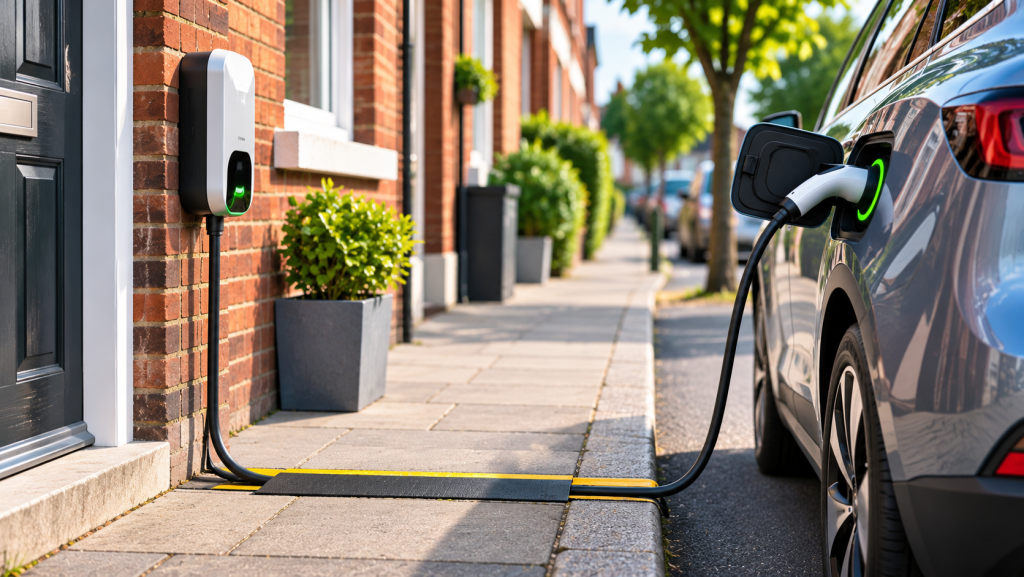
Cross-pavement charging allows an electric vehicle parked on the street to receive electricity from a nearby residential property.
Rather than leaving an exposed charging cable across the pavement, an approved installation uses a purpose-designed channel within the footway.
The charging cable can then pass through the channel between the home and the parked vehicle.
A typical arrangement involves:
A suitable charging point installed at the property.
An approved cable channel embedded in the pavement.
A charging cable passing safely through the channel.
An electric vehicle parked in a suitable position on the street.
The purpose is to provide access to domestic charging while reducing the risks associated with loose cables across pedestrian routes.
This is particularly relevant for households in terraced streets and residential areas where private driveways are unavailable.
Why Does This Matter?
Drivers with private off-street parking can often install home charging equipment more easily.
However, those who rely on on-street parking may have fewer options.
Without access to suitable home charging, some motorists depend more heavily on public charging infrastructure.
Cross-pavement solutions could help address this difference where local circumstances and highway authority requirements allow.
Motor Bridge Insight: Cross-pavement charging may improve access to domestic electricity tariffs, but suitability depends on the property, pavement, parking arrangements and local authority approval.
How Much Could Drivers Save?
The government’s announcement identifies two potential financial benefits.
These should be considered separately.
1. Up to £300 on Installation-Related Costs
Removing the separate planning application requirement for qualifying installations could reduce the initial cost of arranging a cross-pavement charging solution.
The government estimates potential savings of up to £300.
However, homeowners may still face other costs, including:
Purchasing suitable charging equipment.
Professional electrical installation.
Installing an approved pavement cable channel.
Highway authority charges or licence fees.
Any necessary electrical or property alterations.
The planning change does not remove these other potential expenses.
2. Access to Lower-Cost Domestic Charging
The Department for Transport has suggested that some drivers could charge at home for as little as 2p per mile under favourable circumstances.
This is an illustrative figure rather than a guaranteed charging cost.
Actual costs depend on the vehicle’s energy consumption, household electricity tariff, charging efficiency and time of charging.
For example, a vehicle travelling three miles per kilowatt-hour on electricity costing 18p per kWh would have an electricity cost of approximately 6p per mile, before accounting for charging losses.
Drivers should therefore calculate their potential savings using their own vehicle and electricity tariff.
The government has also highlighted possible annual running-cost savings of up to £1,750 in certain comparisons.
However, individual motorists should not assume they will achieve that saving.
Official source: GOV.UK — Drivers to save up to £300 on home EV charging installations.
Can Anyone Now Install an EV Charging Cable Across a Pavement?
No. The new rules do not provide unrestricted permission to install charging cables across public footways.
This is one of the most important points for motorists to understand.
Although the planning requirements have changed, residents must still obtain appropriate authorisation from the relevant highway authority.
The new permitted development rights specifically cover qualifying installations undertaken by, on behalf of, or with the authorisation of a highway authority.
Other permissions, including those relating to highway works, may still be required.
What About Conservation Areas and Listed Buildings?
The new cross-pavement permitted development right does not apply where the proposed installation would be:
Within a scheduled monument site.
Within the curtilage of a listed building.
Within a conservation area.
A proposal in one of these locations may require a different approval route, and permission is not guaranteed.
Other planning, heritage, electrical safety and highway requirements may also apply.
Motorists should contact their local authority before purchasing equipment or arranging installation.
Official legislation: The Town and Country Planning (General Permitted Development) (England) Order 2015 — Schedule 2, Part 9.
Is It Legal to Run an EV Charging Cable Across the Pavement?
Drivers should not assume that placing a loose cable across a public pavement is acceptable simply because they own the property beside it.
Trailing cables can create hazards for pedestrians, including wheelchair users, people with mobility difficulties and those with visual impairments.
There may also be highway restrictions, local authority requirements and liability considerations.
The new rules are intended to support authorised cross-pavement charging solutions, not unrestricted use of loose cables across pedestrian routes.
For qualifying home chargers where the charging cable crosses a footway, the amended permitted development conditions require an authorised cross-pavement solution.
Motor Bridge Safety Advice: Never cut into a public pavement or install a cable channel yourself without the necessary authorisation. Seek approval from your highway authority and use appropriately competent installers.
You can read the relevant requirements in the official 2026 amendment to England’s permitted development regulations.
Who Could Benefit From the New Rules?
The changes are particularly relevant to motorists who live in properties without private off-street parking.
Potential beneficiaries include residents of terraced houses, households that regularly park on the street and some occupants of properties where a suitably located charging point could connect to an authorised pavement channel.
However, having no driveway does not automatically mean a property is suitable.
Several practical factors need to be considered.
Property Location
The position of the home relative to the pavement and road can affect whether a safe installation is possible.
Pavement Suitability
The highway authority may need to consider pavement width, underground utilities, accessibility and other local conditions.
Parking Arrangements
A suitable charging channel does not automatically provide a reserved parking space.
Drivers who rely on public on-street parking may find that their usual space is occupied.
Electrical Installation Requirements
The property must have a suitable electrical supply, and the charging equipment must be installed safely.
Highway Authority Approval
The relevant authority must authorise the cross-pavement solution and may impose conditions.
Motor Bridge Tip: Before committing to an installation, establish whether your local authority supports cross-pavement charging and what application process applies.
Are Government Grants Available for Home EV Chargers?
Yes. Separate government grant schemes may help eligible motorists with the cost of purchasing and installing EV charging equipment.
These grants are different from the potential £300 saving associated with the new planning rules.
From 1 April 2026, the government increased several chargepoint grant limits to up to £500.
Eligible schemes include support for certain renters, flat owners and households with on-street parking.
Home EV Charging Grant Options
| Grant category | Potential support | Key eligibility consideration |
|---|---|---|
| Renters and flat owners | Up to £500 | Requires qualifying private off-street parking |
| Households with on-street parking | Up to £500 | Requires a qualifying cross-pavement solution |
| Residential landlords | Up to £500 per socket | Subject to landlord scheme conditions |
| Eligible workplaces | Up to £500 per socket | Subject to Workplace Charging Scheme requirements |
The maximum grant is not necessarily the amount every applicant will receive.
Eligibility conditions, eligible costs and application procedures must be satisfied.
The government currently states that the relevant home and workplace schemes are available until 31 March 2027.
Could You Benefit From Both the New Rules and a Grant?
Potentially.
An eligible applicant may benefit from the removal of a planning application requirement while separately qualifying for financial support towards charging equipment.
However, this does not mean every applicant can automatically combine the maximum £300 planning saving with a £500 grant.
The actual financial benefit depends on the individual installation, applicable costs and grant conditions.
Official government guidance:
GOV.UK — Electric Vehicle Chargepoint Grants
GOV.UK — Chargepoint Grant Changes from April 2026
What Should Drivers Do Before Installing Cross-Pavement Charging?
If you’re considering an electric vehicle charger but don’t have a private driveway, the following steps can help you make an informed decision.
Step 1: Contact Your Local Council
Ask whether cross-pavement charging installations are supported in your area.
Find out which authority is responsible for the pavement and whether an approved installation scheme operates locally.
Step 2: Check Whether Your Property Is Suitable
Consider the position of the property, pavement and usual parking location.
A professional assessment may be necessary.
Step 3: Confirm the Required Permissions
Check highway authority requirements, any applicable licences, street works permissions and property-related approvals.
Do not assume that the removal of planning permission means all other permissions have disappeared.
Step 4: Obtain an Installation Quotation
Ask a competent installer for a detailed quotation covering the charging equipment, electrical work and any associated costs.
Where pavement works are involved, establish who is authorised to complete them.
Step 5: Check Government Grant Eligibility
Before paying for installation, review the current government grant requirements and application process.
Some schemes require particular documentation or an approved installer.
Step 6: Consider Your Parking Arrangements
Think about how reliably you can park near the charging point.
Where parking is unrestricted, another vehicle may occupy the space you normally use.
Motor Bridge Advice: Obtain written confirmation of the necessary approvals before committing to significant installation costs.
What About EV Drivers Who Cannot Charge at Home?
Cross-pavement charging will not be suitable for every property.
Some motorists may live too far from suitable parking, face physical restrictions or be unable to obtain the necessary permissions.
Others may prefer using public charging infrastructure.
For these drivers, identifying convenient and suitable charging locations remains important.
Find Public EV Charging Points With Motor Bridge UK
The Motor Bridge UK EV Charge Finder helps drivers explore public electric vehicle charging locations.
Using available charging-location information, motorists can search for suitable charging points and review the details provided by the data source.
Depending on the information available, drivers can explore:
Nearby EV charging locations.
Available connector types.
Charging power information.
Location and access details.
Other useful charging-station information.
Find EV Charging Near You
Whether you’re travelling locally or planning a longer journey, knowing where suitable charging points are located can make electric motoring more convenient.
Explore the Motor Bridge UK EV Charge Finder
Visit Motor Bridge UK to access our motoring tools and charging information.
Charging locations, availability, prices and access arrangements may change. Always confirm current information with the relevant chargepoint operator before travelling.
Are Further EV Charging Rule Changes Planned?
The government is also considering additional changes intended to improve access to electric vehicle charging.
These proposals are separate from the cross-pavement planning changes that came into force on 21 October 2026.
Greater Charging Access for Tenants and Leaseholders
The government launched a consultation on 21 October 2026 examining how tenants and leaseholders could obtain clearer and more consistent access to EV charging installations.
The proposals include possible changes to the way landlords and freeholders respond to charging requests.
However, these proposals are not yet established legal requirements.
The consultation remains open until 16 December 2026.
Official consultation: GOV.UK — Expanding EV Charging Access for Tenants and Leaseholders.
EV Chargers in Covered Car Parks
Another consultation considers whether EV charging requirements should be extended to certain covered car parks associated with new buildings or major renovations.
These are proposed changes rather than rules already in force.
Official consultation: GOV.UK — Building Regulations and EV Charging Infrastructure.
Frequently Asked Questions
Do I still need planning permission for a cross-pavement EV charger?
In England, qualifying installations can now benefit from permitted development rights, meaning a separate planning application is not required.
However, the installation must meet the relevant legal conditions, and highway authority authorisation and other permissions may still be necessary.
When did the new EV charging rules come into force?
The changes came into force in England on 21 October 2026.
Does the £300 saving apply to everyone?
No.
The government estimates that removing the planning application requirement could save eligible applicants up to £300.
Individual savings depend on the circumstances of the installation.
Can I install a charging cable channel myself?
You should not undertake unauthorised works on a public pavement.
Qualifying installations must be undertaken by, on behalf of, or with the authorisation of the relevant highway authority.
Can I reserve the parking space outside my house?
Installing an approved charging channel does not automatically give you exclusive rights to a public parking space.
Local parking arrangements remain relevant.
Are the new rules available throughout the UK?
The planning changes discussed in this article apply to England.
Planning and highway arrangements may differ in Scotland, Wales and Northern Ireland.
Residents elsewhere in the UK should check the requirements of their relevant authorities.
Is a £500 home EV charger grant available?
Certain eligible households may qualify for government assistance of up to £500.
Different conditions apply depending on whether you rent, own a flat or rely on on-street parking.
Check the official GOV.UK chargepoint grant guidance before applying.
Will charging at home always cost 2p per mile?
No.
The government’s 2p-per-mile figure represents a potential cost under favourable circumstances.
Actual charging costs depend on the electricity tariff, vehicle efficiency, charging losses and other factors.
Final Thoughts: A Useful Change for Drivers Without Driveways
The introduction of new cross-pavement charging rules could make home EV charging more accessible for some motorists in England.
By removing the need for a separate planning application for qualifying installations, the government estimates that drivers could save up to £300 in upfront costs.
For households without private driveways, the changes may also provide another route to using domestic electricity for vehicle charging.
However, the new regulations do not remove the need for appropriate authorisation, safe installation or compliance with highway requirements.
Drivers should check their individual circumstances before purchasing equipment or arranging work.
At Motor Bridge UK, we believe access to clear, practical information helps motorists make smarter decisions about their vehicles.
Whether you’re considering installing home charging equipment or looking for public charging locations, understanding your available options is an important starting point.
Looking for EV Charging Locations?
Explore public electric vehicle charging points with the Motor Bridge UK EV Charge Finder.
Visit motor-bridge.co.uk to discover our motoring tools.
Motor Bridge UK — Bridging the gaps to smarter motoring.
Official Government Information and Sources
For more information about the new regulations, drivers can consult the following official resources.
Department for Transport — EV Charging Rule Changes
The government’s announcement explaining the planning changes introduced on 21 October 2026.
Read the Official Government Announcement
UK Legislation — Cross-Pavement Charging
The legislation establishing the new permitted development rights and their limitations.
GOV.UK — Electric Vehicle Chargepoint Grants
Information about available government grants, eligibility and applications.
Explore Government EV Charging Grants
GOV.UK — EV Charging for Tenants and Leaseholders
The government’s consultation on proposals to improve charging access for rented and leasehold properties.
Read the Government Consultation
GOV.UK — EV Charging Building Regulations
Proposals relating to EV charging infrastructure in covered car parks.
Read the Building Regulations Consultation
Important Information
This article provides general information about electric vehicle charging regulations and government support schemes as of 3 November 2026.
The cross-pavement permitted development rights discussed in this article apply to England and are subject to specific conditions and restrictions.
Removal of the relevant planning permission requirement does not remove the need for highway authority authorisation, applicable licences, other statutory approvals or compliance with relevant electrical safety requirements.
Government estimates of potential installation and running-cost savings are illustrative. Individual savings are not guaranteed.
Government grants are subject to eligibility conditions, funding availability and applicable scheme rules.
Property owners, tenants and leaseholders should obtain all necessary permissions before undertaking installation work.
Motor Bridge UK does not provide legal, planning or electrical installation advice. Readers should consult their local highway authority and appropriately qualified professionals regarding individual installations.
Motor Bridge UK is an independent motoring information platform and is not affiliated with or endorsed by the Department for Transport or the UK Government.
Published: 3 November 2026
Motor Bridge UK — Bridging the gaps to smarter motoring.