Buying a Car With MOT Advisories: What Should You Check?
Buying a car with MOT advisories can be reasonable, provided you understand what was recorded, whether anything has been repaired and what the vehicle needs now.
An advisory is a reason to ask questions, rather than an automatic reason to reject a car. Equally, a seller saying “it passed its MOT” should not end your checks.
The important question is whether the car’s present condition and likely maintenance costs make it a sensible purchase.
What does an MOT advisory mean?
An advisory highlights something the tester considers worth monitoring that may need attention. It does not, by itself, cause an MOT failure.
Advisories and minor defects are different. A vehicle can pass with either recorded, while major or dangerous defects result in a failure. GOV.UK explains the different MOT outcomes. GOV.UK
An advisory describes an observation at the time of testing. It does not tell you exactly how long a component will last or provide a guaranteed repair deadline.
1. Read the full MOT history
Start with the latest result, then look back through previous tests.
Pay attention to:
- The wording of each advisory and when it was recorded.
- Similar issues appearing across several tests.
- Previous failures and the results of subsequent tests.
- Recorded mileage and any discrepancies that need explaining.
- How far the vehicle has travelled since its latest MOT.
You can use Motor Bridge’s MOT Checker & Explainer to explore available results and understand recorded defects.
Repeated advisories are a prompt to investigate. They do not automatically prove neglect, but they make repair records and a current inspection particularly useful.
2. Ask for evidence of completed repairs
If the seller says an advisory has been dealt with, ask what work was done and request supporting paperwork.
Useful evidence includes an invoice showing the vehicle registration, repair date, mileage and details of the parts or work supplied.
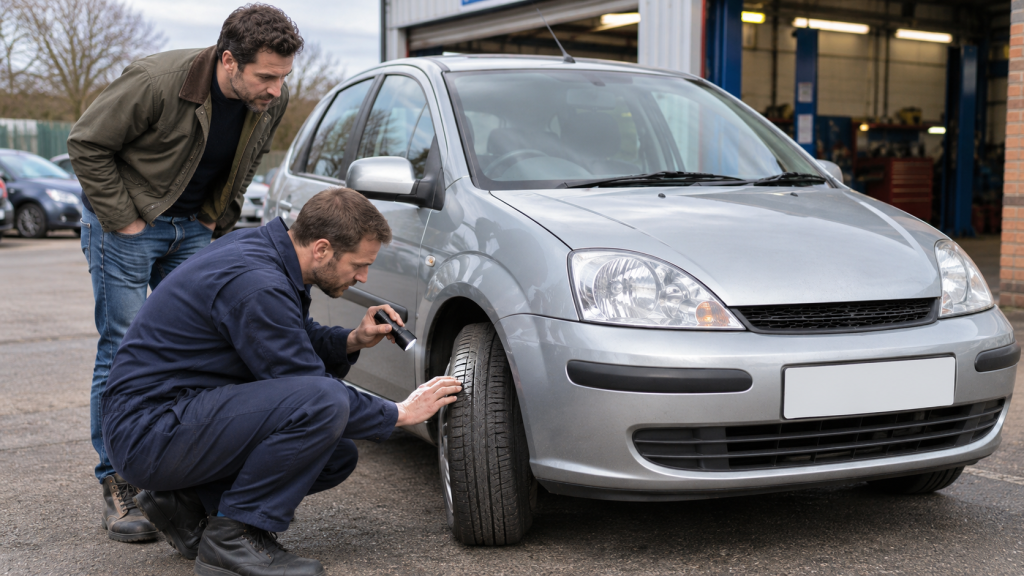
For example, if a tyre advisory was addressed, check which tyre was replaced. If suspension work was completed, ask which component and which side of the vehicle were involved.
An advisory disappearing from a later MOT does not, on its own, prove a repair took place. DVSA explains that recording advisory items involves tester judgement. Check the vehicle and supporting evidence rather than relying solely on the absence of a later entry. Matters of Testing
3. Find out what the advisories mean for this car
The number of advisories is less useful than their nature and the vehicle’s current condition. One potentially expensive problem can matter more to a buyer than several straightforward maintenance items.
Use the following questions to guide a discussion with the seller or an independent garage:
| Advisory area | Questions to ask before buying |
|---|---|
| Tyres | What is their condition now? Have any been replaced, and has uneven wear been investigated? |
| Brakes | Has the braking system been inspected since the advisory? What work, if any, is recommended now? |
| Suspension or steering | Which component was identified? Has it been repaired or assessed recently? |
| Corrosion | Where is it, how extensive is it and has a professional assessed its significance? |
| Fluid leaks | Has the source been identified? Is there a written diagnosis or repair invoice? |
| Restricted inspection | What could not be inspected, and would a separate inspection help clarify its condition? |
These are inspection prompts, not diagnoses. Similar wording can have different implications depending on the component, location and condition.
For unresolved concerns, explore Motor Bridge’s Garage, Servicing, Repair & MOT page to find relevant services.
4. Get repair estimates before negotiating
Avoid guessing what an advisory will cost to address. Ask a garage for an estimate based on the exact vehicle and, where necessary, a physical inspection.
Clarify whether the estimate includes parts, labour, VAT and any related work.
Then consider the total purchase cost:
Asking price + identified work + servicing due + a maintenance allowance.
A discount may help cover expected work, but it does not resolve uncertainty about the vehicle’s condition. If the extent of a problem remains unclear, investigate before paying a deposit or agreeing to buy.
5. Consider an independent inspection
An independent inspection can be particularly useful where advisories remain unresolved, repair evidence is missing or the seller’s explanation does not match the records.
Ask the inspector specifically to assess the areas identified in the MOT history, alongside the wider vehicle condition. Check the inspection’s scope and limitations before booking.
A test drive may reveal concerns, but it cannot establish the condition of every component. Only drive if the vehicle is roadworthy and the appropriate insurance and permissions are in place.
Does a fresh MOT mean the car is a safe buy?
A fresh MOT is useful information, but it is not a comprehensive mechanical inspection or a promise of future reliability.
GOV.UK explains what the MOT covers, including that it does not assess the condition of the engine, clutch or gearbox. A clean result should therefore be considered alongside servicing records, documentation and the vehicle’s present condition. GOV.UK
Check more than the MOT
MOT records are only one part of buying a used car.
The official GOV.UK used-vehicle buying checklist recommends checking vehicle details, MOT history, recall information and identification documents. GOV.UK
Motor Bridge can also help you explore:
- Vehicle History Checks for information that may include recorded finance, theft or insurance write-offs, depending on the provider.
- Safety Recall Checker for available recall-status information and manufacturer support routes.
A clear history or recall result does not guarantee that a vehicle is free from faults or other concerns.
When should you reconsider the purchase?
Pause if the seller refuses reasonable checks, cannot explain important discrepancies or pressures you to pay before unresolved concerns have been assessed.
The same applies if likely repairs would leave you without enough money for essential maintenance after buying.
You do not need to establish that a car is definitely unsuitable before deciding it carries more uncertainty than you are comfortable accepting.
Frequently asked questions
Should I avoid every car with MOT advisories?
No. Assess what the advisories concern, the evidence of repairs and the vehicle’s current condition. The decision should reflect the whole car and its total cost.
How many MOT advisories are too many?
There is no useful universal number. Focus on the significance of each item, whether issues recur and what an inspection finds.
Must the seller repair every advisory before selling?
Do not assume every advisory must be repaired simply because the car is being sold. Agree clearly what work will be completed and record any promises in writing. The vehicle’s roadworthiness and your consumer rights are separate considerations.
Can I wait until the next MOT to address an advisory?
Do not treat the next MOT date as a repair deadline. Ask a qualified professional what attention is needed now and how any remaining issue should be monitored.
Is a car with no advisories always a better purchase?
No. Compare maintenance evidence, inspection findings, condition and price. An empty advisory list does not establish overall mechanical health.
Motor Bridge’s advice: Buy on evidence. Understand the advisories, check what has been done and establish what still needs attention before deciding whether the price is right.
Information checked on 10 November 2026. This guide focuses on the Great Britain MOT system; Northern Ireland has separate testing arrangements. General buying guidance only, not a vehicle diagnosis. MOT records describe findings at the time of testing and cannot guarantee current condition or future reliability.