Motor Bridge UK | UK Motoring Guide
Nobody plans to break down. But a little preparation can make an unexpected roadside situation much easier to manage.
Whether you're commuting, travelling long distances or heading out in winter, having the right essentials in your vehicle can help you stay prepared.
Discover what to include in your emergency kit, how to use your equipment safely and what to do if your vehicle develops a problem.
← Back to UK Motoring Guide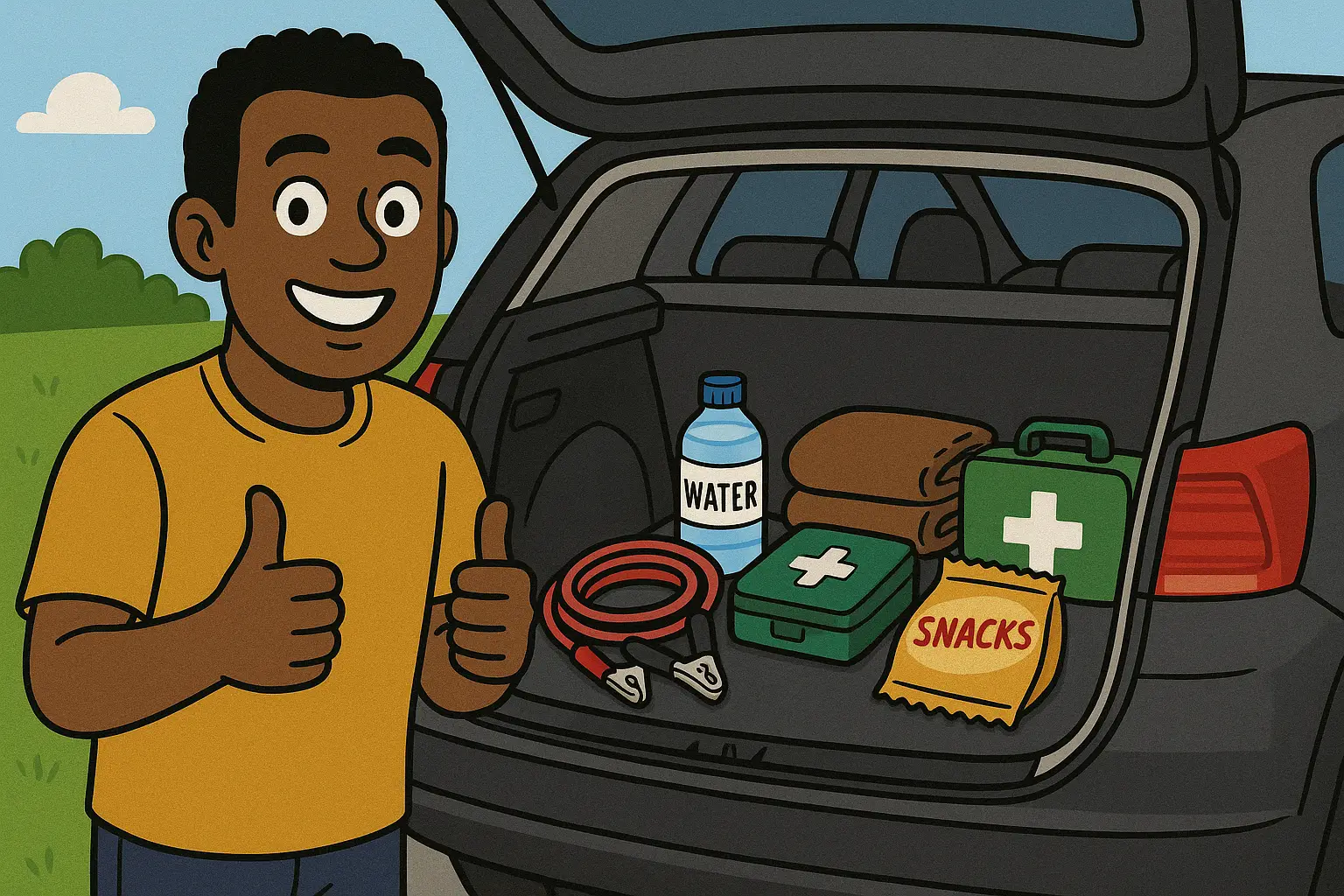
01 | Why prepare?
An emergency kit cannot prevent every breakdown, but it can help you deal with unexpected delays and stay more comfortable while waiting for assistance.
Suitable reflective clothing and lighting can help others see you when it is safe to be outside your vehicle.
A charged phone, essential supplies and breakdown details can make arranging help easier.
Water, warm clothing and other essentials can help during an unexpected wait.
02 | Safety and visibility
Visibility equipment can be useful if you experience a breakdown. However, where and how you use it matters.
Reflective or fluorescent clothing can make you more visible in certain roadside situations.
Keep a suitable high-visibility vest somewhere you can reach it easily, ideally without needing to access the boot.
However, wearing high-visibility clothing does not make standing near moving traffic safe.
A compact LED torch can be useful for finding equipment or checking your surroundings where it is safe to do so.
Consider a rechargeable torch, wind-up model or spare batteries.
Check that it works regularly and store it securely.
On an ordinary road, where it is safe to do so, the Highway Code advises placing a warning triangle at least 45 metres behind a broken-down vehicle on the same side of the road.
Take great care when placing or retrieving it.
Never place a warning triangle on a motorway.
Do not attempt to place one anywhere if doing so would put you or others at risk.
Use hazard warning lights to warn other road users when your vehicle is temporarily obstructing traffic or creating a hazard.
On a motorway or unrestricted dual carriageway, they may also be used briefly while moving to warn following traffic of a hazard ahead.
Follow the Highway Code and never rely on hazard lights alone to protect you from moving traffic.
03 | Breakdown essentials
Some equipment can help with minor vehicle problems, but only when you are somewhere safe and understand how to use it.
Jump leads or a suitable portable booster can be useful for some conventional 12-volt battery problems.
Always follow the vehicle and equipment manufacturers' instructions.
Incorrect connections can cause damage or injury.
Some vehicles, including hybrids and electric vehicles, have specific restrictions or procedures. Do not assume conventional jump-starting methods are appropriate.
A suitable portable inflator may help correct low tyre pressure when there is no serious damage.
A tyre repair kit may be useful for certain punctures, but it is not suitable for every type of tyre damage.
Follow the tyre and vehicle manufacturers' instructions.
Never attempt tyre repairs in an unsafe roadside location.
A compact toolkit might include suitable screwdrivers, pliers, a spanner or other equipment recommended for your vehicle.
Only attempt tasks that are safe and within your competence.
Vehicle-specific equipment and manufacturer instructions should take priority over generic advice.
A tow rope is not essential for every motorist and is not appropriate for every vehicle.
Towing a disabled vehicle can involve legal requirements, technical restrictions and significant safety risks.
Modern vehicles may require specific recovery procedures.
If unsure, use a professional recovery service rather than attempting an unsuitable tow.
04 | Seasonal preparation
Your emergency kit should reflect the conditions you might encounter. Winter journeys and summer journeys can bring different challenges.
Check weather warnings and road conditions before travelling.
If severe weather makes a journey unsafe, consider postponing it.
Avoid leaving medicines, batteries or other temperature-sensitive items in extreme heat where this conflicts with their storage instructions.
Never leave children or animals in conditions where they could overheat inside a parked vehicle.
Remember that mobile phone coverage may be limited in some rural areas.
Plan suitable stopping points before travelling.
05 | Personal essentials
Some of the most valuable emergency-kit items are inexpensive, compact and easy to overlook.
Keep your mobile phone charged and carry a suitable charging cable or power bank.
Have important contact details available, including breakdown assistance and emergency contacts.
If you are in immediate danger, call 999.
Water, suitable non-perishable snacks, warm clothing and basic hygiene supplies can be useful.
Store items securely and replace anything that is damaged, expired or unsuitable for the temperature.
A compact first aid kit may contain sterile dressings, plasters, gloves and other suitable basic supplies.
Choose equipment appropriate to your needs and check expiry dates.
First aid supplies do not replace training, professional medical assistance or emergency services.
Keep accessible information about your breakdown cover, vehicle insurance and relevant emergency contacts.
For longer journeys, consider keeping offline navigation information in case your phone loses its connection.
Avoid leaving unnecessary sensitive personal documents where they could be stolen.
06 | If you break down
An emergency kit is useful, but knowing how to respond to a breakdown is even more important.
If possible, move your vehicle somewhere safe and away from moving traffic.
Use hazard warning lights where appropriate to warn others.
Consider your surroundings before leaving the vehicle.
On an ordinary road, a warning triangle may be appropriate where it can be positioned safely and without creating additional risk.
Contact breakdown assistance and follow the Highway Code guidance for the circumstances.
If possible, leave the motorway at the next exit or pull into a service area.
If that is not possible, follow the Highway Code's motorway breakdown procedures.
Where appropriate, move left to an emergency area or hard shoulder and stop as far left as possible.
Switch on hazard warning lights.
Where it is safe to exit, leave on the side away from moving traffic and get behind a safety barrier if one is available.
Keep well away from the carriageway and moving vehicles.
Never place a warning triangle on a motorway.
Do not attempt roadside repairs in a dangerous location.
If you cannot reach a place of relative safety and are stopped in a live traffic lane, remain in the vehicle with seat belts fastened, keep hazard lights on and call 999 immediately.
The correct action depends on where the vehicle has stopped and the immediate hazards.
If your vehicle is stopped in a live motorway lane and you cannot reach a place of relative safety, remain inside with seat belts fastened and call 999.
Explain your location and situation clearly.
Follow instructions from emergency services.
07 | Test your knowledge
Three realistic roadside situations. Choose an answer and reveal the explanation.
These are educational exercises, not a substitute for emergency-service instructions.
Your vehicle has stopped on a motorway hard shoulder. You have a warning triangle in the boot.
You must never place a warning triangle on a motorway.
Follow the Highway Code's motorway breakdown guidance instead.
Follow the appropriate motorway breakdown procedures, move away from traffic where safe and arrange assistance.
Do not put yourself at risk retrieving or placing equipment.
Attempting repairs close to moving motorway traffic can expose you to serious danger.
You notice a puncture while travelling along a busy road.
If the vehicle can be controlled, move to a safe stopping place where possible.
Avoid creating an unnecessary obstruction or putting yourself at risk.
Find a safe location if possible and arrange assistance where appropriate.
Only use tyre equipment if the location and circumstances make doing so safe.
Continuing normally on a seriously damaged or deflated tyre can cause further damage and create safety risks.
You are waiting for breakdown assistance and your phone has little charge remaining.
Unnecessary phone use can reduce the remaining battery charge.
Preserve your ability to contact assistance and provide your location.
Use a suitable power bank if available and safe to access.
A working phone can be important when contacting breakdown services or emergency assistance.
08 | Common questions
There is no general requirement for every privately used car in the UK to carry a complete emergency kit.
However, particular vehicle types, commercial operations or journeys abroad may be subject to additional requirements.
Carrying suitable equipment remains a sensible precaution.
Store equipment securely so it cannot move around dangerously during braking or a collision.
Keep frequently needed items, such as a high-visibility vest or phone charging cable, somewhere safely accessible.
Avoid placing loose tools or heavy items in passenger areas.
Check it periodically and before longer journeys.
Inspect batteries, torches, first aid supplies, food, water and other items for damage, expiry or loss of effectiveness.
Recharge equipment where necessary.
No. Emergency supplies and breakdown assistance serve different purposes.
A kit can help with preparation and comfort, while a breakdown provider may be needed to diagnose, repair or recover a vehicle.
Check your policy carefully, including exclusions, call-out arrangements and the level of recovery provided.
09 | Interactive checklist
Use this checklist to review your current equipment. Not every item will be necessary for every driver or vehicle.
Checklist selections are temporary. No information is submitted or stored by this guide.
10 | Official safety information
The Highway Code and Met Office provide further information on breakdown safety and preparing for difficult weather.
Rules 275–287 include guidance on responding to breakdowns, using warning devices and keeping people away from moving traffic.
Read official Highway Code breakdown guidanceIncludes guidance on motorway stopping restrictions, emergency areas and safe procedures.
Read official motorway guidanceFind practical advice about preparing for winter travel and carrying suitable supplies.
Read the Met Office winter car kit guidance