
UK motoring guide · Roadside safety
Protecting Road Workers and Recovery Operators
Road workers, traffic officers and breakdown recovery crews keep Britain moving—often only metres from passing vehicles. Discover what drivers can do to give them space, understand road signs and respond safely to roadside incidents.
← Back to UK Motoring Guide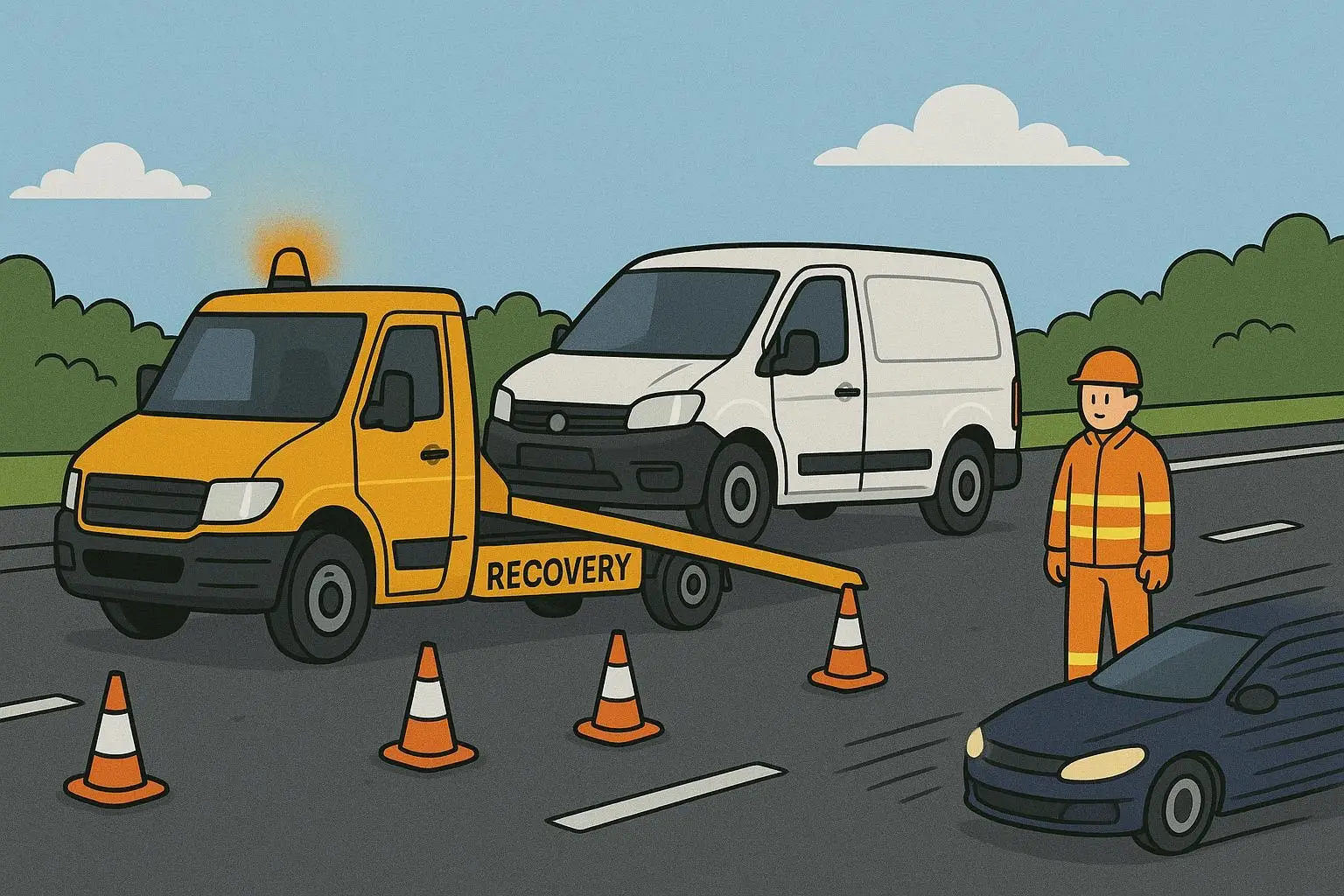
Every journey has a part to play
Someone may be repairing a barrier, clearing debris, recovering a damaged vehicle or helping a stranded driver. Safe road-user behaviour makes their work less dangerous. The key is to notice early, obey the signs, leave space where safely possible and keep your attention on the road.
Look well ahead
Watch for cones, temporary signs, beacons, high-vis clothing and changing traffic patterns.
Control your speed
Obey temporary limits and adjust to conditions. Slow smoothly; avoid sudden braking.
Leave space safely
Where lawful and safe, create more room. Never swerve, cut across traffic or enter a closed lane.
The six things drivers can do
Simple choices make a big difference. Tap a topic to see why it matters.
1. Spot the work zone early
Scan well ahead for advance warning signs, temporary lane markings, cones, flashing amber lights and staff at the roadside. Give yourself time to respond smoothly.
2. Obey temporary speed limits
A posted temporary maximum speed limit is a legal limit, not a suggestion. Choose a lower speed if traffic, visibility or the road layout demands it. Do not brake sharply just to look at an incident.
3. Give people space — only when safe
If there is a safe, permitted opportunity to use another open lane, doing so may increase separation. Do not treat a “move over” campaign as permission to change lanes abruptly, force another driver aside or cross a solid line. There is no single blanket UK rule requiring every driver to change lanes past a recovery vehicle.
4. Respect the red X
A red X over a motorway lane means that lane is closed. You MUST NOT drive in it. Move into an open lane in line with the displayed instructions, even if you cannot see a hazard. See Highway Code rule 258.
5. Avoid distractions and rubbernecking
Look where you are going, maintain a safe following distance, and do not film or stare at roadside workers or incidents. A distraction can cause a secondary collision.
6. Follow authorised directions
Follow applicable traffic signs and lawful directions from police or traffic officers. Temporary traffic-management layouts can change rapidly; never assume a lane is open because it looks clear.
Spot the situation: what would you do?
Test your roadside judgement. Open each situation for the recommended response.
There is a recovery truck with amber beacons on the hard shoulder.
Keep your eyes on the carriageway ahead. Maintain a safe speed and distance. If an adjacent open lane is available and a lane change is safe and lawful, you can create more space. Do not make a sudden manoeuvre or slow unnecessarily to watch.
The gantry shows a red X above your lane, but you see no obstruction.
Follow the advance signs and safely move to an open lane. Do not drive under the red X: road workers, vehicles or debris may be hidden farther ahead.
You reach roadworks with a signed 40 mph limit. Traffic is moving faster.
Do not exceed the signed maximum. Allow a safe gap ahead and avoid reacting to pressure from following drivers.
A motorway vehicle is stranded in a live lane and occupants appear at risk.
Do not stop in a live lane to investigate or attempt to move people yourself. From a safe place, contact 999 and provide the carriageway, direction and location markers if known. Follow the emergency services’ instructions.
Know the people behind the cones and beacons
Recovery operators
Recover broken-down or damaged vehicles and assist stranded motorists. Their work may include loading on the hard shoulder or at a managed incident scene.
Road maintenance crews
Maintain road surfaces, barriers, drainage, lighting and signs—sometimes at night or in narrow work zones.
Traffic officers
On the relevant strategic road networks, manage incidents, set up safety measures and help keep traffic moving; they are not police officers.
Emergency responders and utilities
Police, ambulance and fire crews, plus utility engineers, may work in or beside live traffic when dealing with urgent incidents.
If you break down: safety comes first
A driver who breaks down can become vulnerable too. The safest response depends on your exact position and whether you can exit safely.
Head for a place of relative safety
If possible, leave the motorway at the next exit or enter a service area. If you cannot, aim for an emergency area or hard shoulder if safely reachable.
If safely stopped to the left, get away from moving traffic
Use hazard lights; if safe, exit on the side away from traffic and move behind a safety barrier where appropriate. Stay alert to drops and other hazards.
If stuck in a live lane or unable to leave safely
Stay in the vehicle with seat belts and hazard lights on. Call 999 immediately and ask for the police. Do not attempt roadside repairs or place a warning triangle on a motorway.
Based on Highway Code rules 275–279. Always prioritise the conditions in front of you and official instructions.
Quick myth check
“If I see amber flashing lights, I must always change lanes.”
Not necessarily. Consider whether moving to another open lane is safe, legal and useful; do not force a lane change. Always comply with signs, directions and traffic conditions.
“A red X does not apply if the lane looks empty.”
False. The lane is closed. The danger may be out of view, and the lane may be required for emergency access.
“I should slow almost to a stop to see what happened.”
False. Stay alert and adjust safely to hazards, but the Highway Code says not to slow unnecessarily when passing an incident, including one on the other carriageway.
“I can put a warning triangle behind a broken-down car on a motorway.”
False. Never place a warning triangle on a motorway. Follow the motorway breakdown guidance instead.
Useful next steps
Explore practical Motor Bridge UK information and services, plus primary safety guidance.
Breakdown & RecoveryMore motoring guidesOfficial roadworks rulesFrequently asked questions
Is “slow down, move over” a UK law?
It is a road-safety campaign message, not a single universal UK statutory obligation to change lanes whenever a breakdown truck is present. Drivers must still follow applicable laws, traffic signs, speed limits and the Highway Code, taking care around people at the roadside. Motor Bridge UK supports the Slow Down Move Over UK campaign and its aim of protecting people working or stranded at the roadside. Where safe and lawful, giving roadside workers more space and reducing speed appropriately can help protect lives.
Can I use a motorway lane showing a red X?
No. You must not drive in a lane marked with a red X. Move safely to an open lane as instructed.
Should I slow down when an incident is on the opposite carriageway?
Be alert to hazards, but do not slow unnecessarily to look. Keep your eyes on your road ahead.
Who should I call if someone is in immediate danger?
Call 999 from a safe position and ask for the appropriate emergency service. Provide the road, direction, junction, nearby markers and a clear description of the hazard if known.
About this Motor Bridge UK guide
Motor Bridge UK Ltd provides independent, general educational information for UK motorists. We are not a highways authority, emergency service or recovery operator and are not affiliated with National Highways or any UK government department. This guide is not legal advice or a substitute for professional or emergency instructions. Requirements can vary by road and jurisdiction; obey current signs, lawful directions and relevant rules. For immediate danger call 999 when safe to do so.
Some linked Motor Bridge UK service pages may include advertisements or referral partnerships, which should be identified on those pages. External resources are operated by their respective organisations.
Sources: Highway Code roadworks · Motorways · Breakdowns and incidents.