
UK MOTORING GUIDE · ROADSIDE SAFETY
How to Handle a Vehicle Breakdown Safely
Broken down? Whether you are on a local road or motorway, knowing what to do next can make a difficult situation safer. This Motor Bridge guide explains the steps in everyday language, with extra help for motorway emergencies.
← Back to UK Motoring GuideInformation reviewed: 20 October 2026 · Applies mainly to Great Britain; Northern Ireland has its own Highway Code.
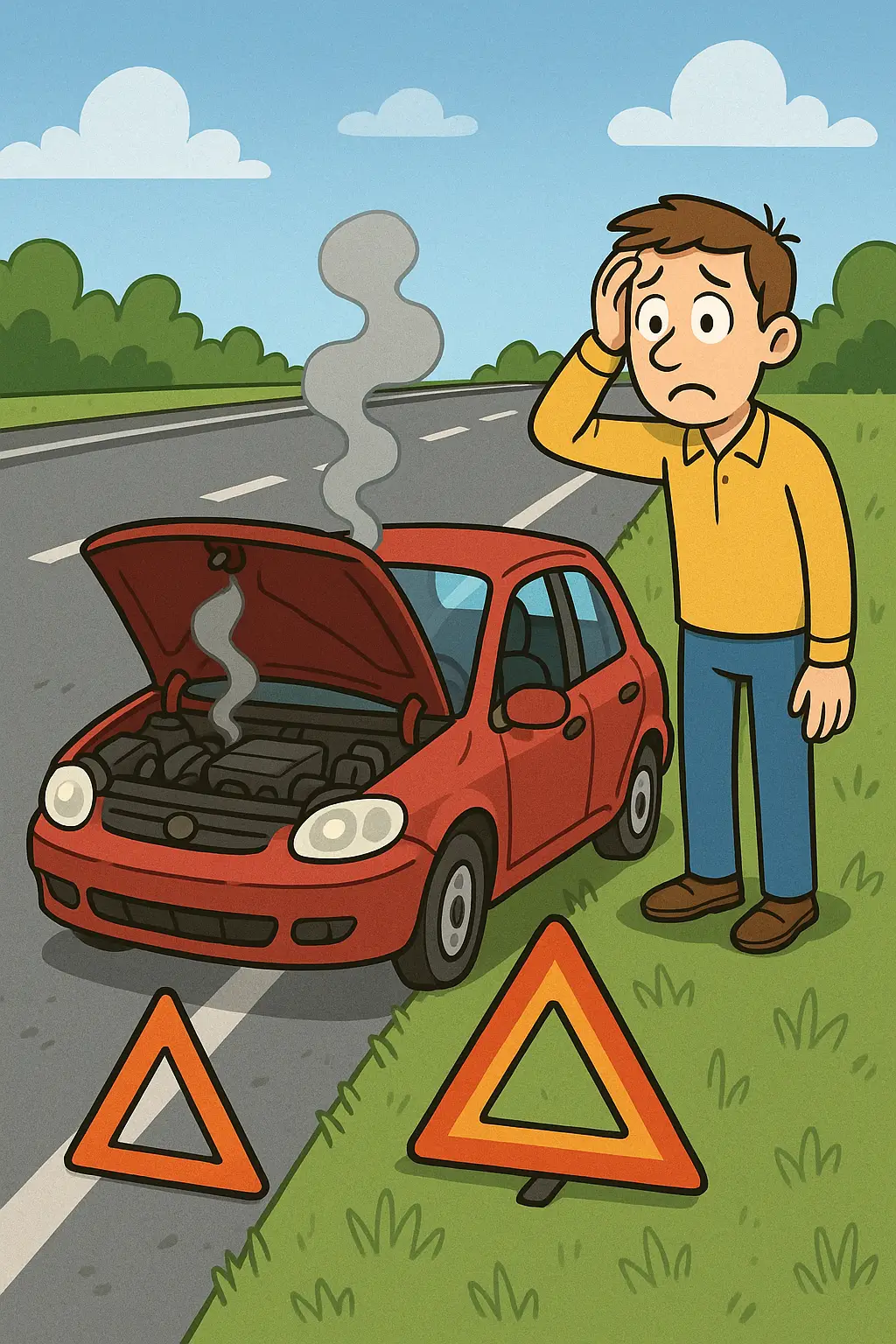
First things first: get left, get safe, get help
If your vehicle develops a fault, your safety comes before the vehicle. On a motorway, try to reach a service area or exit if you can safely do so. If that is not possible, use an emergency area or hard shoulder where available. Never put yourself in danger trying to move a vehicle.
Immediate danger on a motorway? If you cannot get to a safer location or cannot safely get out and away from traffic, stay belted in, keep hazard lights on and call 999 for the police immediately.
What to do when your vehicle breaks down
Tap any card for the practical next steps. These cover the original guide’s advice, updated to reflect the Highway Code.
Stay calm and spot the danger
Tap for useful advice
Take a moment to assess what is happening. Keep control of the vehicle and avoid sudden movements. If your vehicle is obstructing traffic, switch on your hazard warning lights.
Worth knowing: Highway Code Rule 276.
Find somewhere safer to stop
Tap for useful advice
If the vehicle can still move safely, aim for a service area, exit, lay-by or other suitable stopping place. On a motorway, use an emergency area or hard shoulder if you cannot leave at the next exit. A hard shoulder is not as safe as a service area.
Worth knowing: Rules 275 and 277.
Help other drivers see you
Tap for useful advice
Keep hazard warning lights on when stopped and causing an obstruction. In darkness or poor visibility, use sidelights where possible. Wear high-visibility or reflective clothing if you have it and can put it on safely.
Worth knowing: Rules 276 and 277.
Get yourself and others safe
Tap for useful advice
On a motorway, if it is safe, leave through the side furthest from moving traffic. Move well away from your vehicle and traffic, behind a safety barrier if there is one. Watch for drops or uneven ground. Keep children close. Do not go back to your vehicle.
Worth knowing: Rule 277.
Know when to stay inside
Tap for useful advice
If you cannot reach a safer stopping place or cannot safely get out and well away from traffic, stay in the vehicle with your seatbelt and hazard lights on. Call 999 immediately and ask for the police, or use your vehicle’s SOS function if available. If a disability prevents you from leaving safely, follow the same emergency advice.
Worth knowing: Rules 277 and 279.
Be careful with warning triangles
Tap for useful advice
Never put a warning triangle on a motorway. On other roads, only if it is safe to place one, the Highway Code advises positioning it at least 45 metres behind your vehicle on the same side of the road. Do not put yourself in danger to set one up.
Worth knowing: Rule 276.
Call the right people
Tap for useful advice
Call your breakdown provider once you are safe. On a motorway, use a free emergency telephone where provided to get advice. If you are trapped in a live lane or cannot get out safely, call 999 and ask for the police. Tell the operator if you need extra help.
Worth knowing: Rule 277.
Explain exactly where you are
Tap for useful advice
Give the road number, direction of travel and nearest junction or landmark. Motorway driver-location signs and marker posts are particularly useful. A phone map or in-car SOS system can also help pinpoint your location.
Worth knowing: Rule 277.
Wait away from moving traffic
Tap for useful advice
Stay in a safe location away from your vehicle and the carriageway. Do not stand between your car and traffic. On motorways, do not attempt roadside repairs. Keep an eye on approaching traffic while speaking to anyone assisting you.
Worth knowing: Rules 276 and 277.
When recovery arrives
Tap for useful advice
Confirm you are dealing with the assistance service you called. Follow the recovery operator’s safety instructions and do not walk back towards the vehicle until they tell you it is safe. If you are in an emergency area, the provided emergency telephone must be used and the operator’s advice followed before rejoining the motorway.
Worth knowing: Rule 278.
Try these everyday breakdown scenarios
What would you do? Open each question to check your answer.
You stop in a live motorway lane. Should you get out?
Can you put a warning triangle behind your vehicle on a motorway?
You are in a motorway emergency area. Can you simply drive straight back out?
Pack a small breakdown kit
The original Motor Bridge checklist is worth keeping. A few simple items can make an unexpected stop more manageable.
Useful items: high-visibility vest, warning triangle (for suitable non-motorway roads), torch, charged phone and charger, first-aid kit, warm blanket or clothes, drinking water and your breakdown provider’s contact details.
A warning triangle and high-vis vest are recommended practical items here, not presented as a blanket UK legal requirement for every private car. Never retrieve equipment if doing so would put you at risk.
Watch: What to do on a motorway
The original page features a National Highways video explaining safer motorway breakdown decisions. Watch it before you travel, not while driving.
If the embedded video is blocked by your browser, consent settings or the video publisher, use the YouTube button instead.
Third-party video: National Highways. Availability and content are controlled by the publisher. Embedding may involve third-party processing; check your site’s consent settings.
When help arrives — and how Motor Bridge can help
Stay somewhere safe and let the recovery team manage the vehicle. Check that the operator is the assistance provider you expected. If you are arranging cover or looking for roadside assistance options, explore Motor Bridge's dedicated breakdown and recovery page.
Relevant Highway Code guidance: Rules 275–279. In an immediate emergency, call 999.